Skip to content
  • Environment
  • Overdose Crisis
  • Homelessness

San Francisco Public Press - Independent, Nonprofit, In-Depth Local News

San Francisco Public Press (https://www.sfpublicpress.org/bay-area-startups-accelerate-californias-covid-19-testing-efforts/)

Menu

  • Search
  • Donate
  • News
    • By Date
    • “Civic” Podcast
    • Homelessness
    • Housing
    • Health
    • Environment
    • Government & Politics
    • More Categories
  • Special Reports
    • March 2024 SF Election Guide
    • Overdose Crisis
    • Reparations
    • Coercive Control: Abuse That Leaves No Marks
    • Left Out – Supportive Housing
    • Public Housing in Private Hands
    • Driving Home: Surviving the Housing Crisis
    • Ride-Hailing’s Dark Data
    • Data Privacy
    • Renters vs. Veritas
    • Remaking Rent Control
    • Solving Homelessness: Part 2
    • Solving Homelessness: Ideas for Ending a Crisis
    • Navigating Homelessness: Which Way Home?
    • Bilingual Schools
    • Sea Level Rise
      • Sea Level Rise: First in a Series
      • Sea Level Rise: 2nd in a Series
    • Past Elections Projects
      • November 2022 Election Guide
      • June 2022 SF Election Guide
      • February 2022 Voter Guide
      • November 2020 SF Voter Guide
      • 2019 Nonpartisan Election Guide
      • Fall 2018 Election
      • Special Election, June 2018
    • More Special Reports
  • ‘Civic’ Podcast
  • KSFP Radio
  • Newsletter
  • About
    • What We Do
    • Who We Are
    • Supporters
    • Ethics Statement
    • Diversity Statement
    • From the Newsroom
    • Newspaper (on hiatus)
      • Back Issues
      • Where to buy the newspaper
    • Contact
  • Menu
  • Environment
  • Overdose Crisis
  • Homelessness

Bay Area Startups Accelerate California’s COVID-19 Testing Efforts

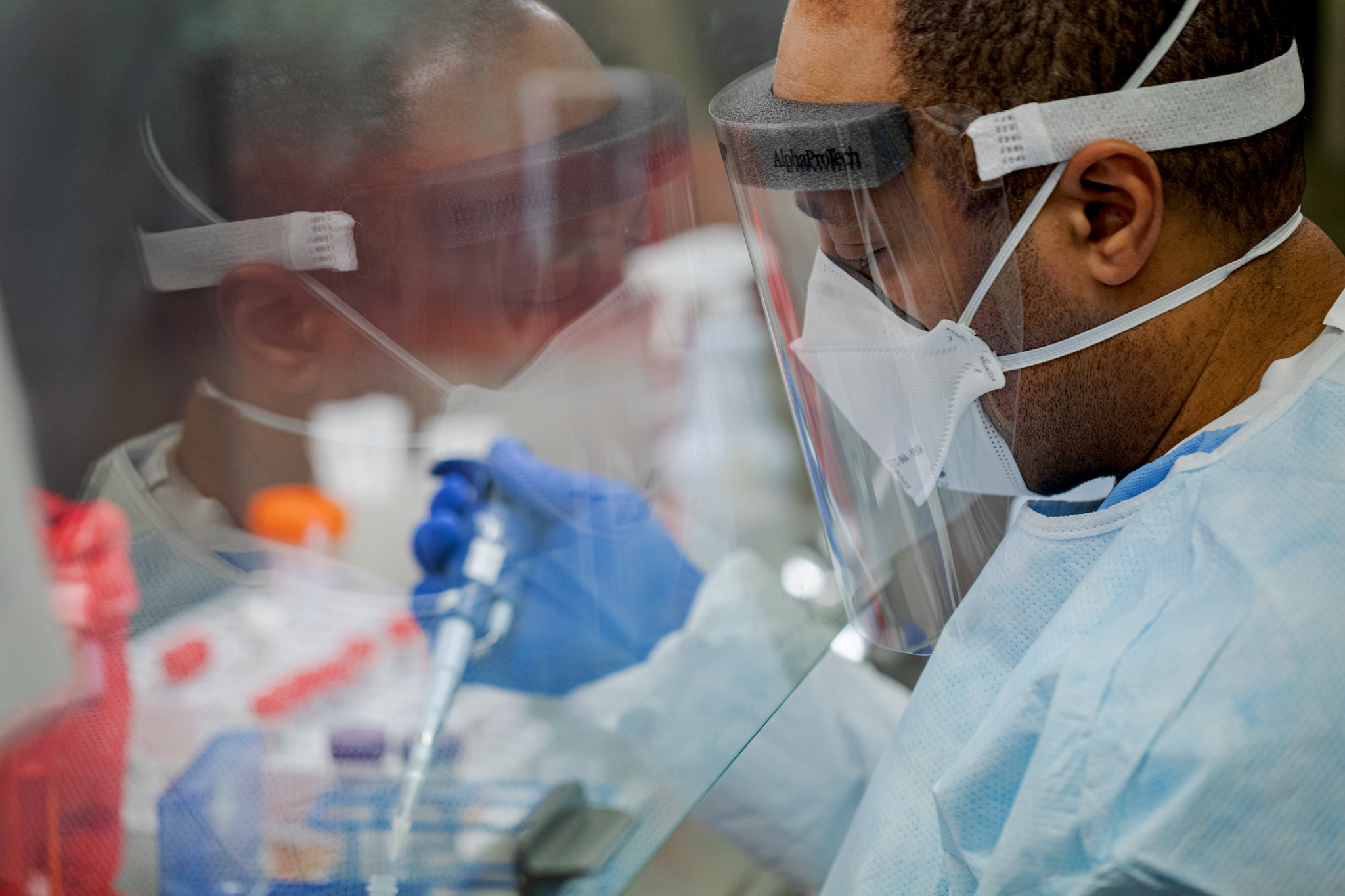
pa_microbiologist_kerry_pollard.jpg

The United States has been slow to roll out widespread testing for COVID-19. Here, a microbiologist performs an extraction of the coronavirus in a Pennsylvania lab. Gov. Tom Wolf / CC By 2.0

04.07.2020
| By Rebecca Bowe Rebecca Bowe, Reporter |
LikeTweet EmailPrint More
  • More on coronavirus
  • Subscribe to coronavirus

At least two Bay Area startups are scrambling to address California’s testing shortage for COVID-19, the disease caused by the novel coronavirus that has unleashed a global pandemic and triggered economic freefall.

Oakland-based Renegade.bio, created just four weeks ago, has raced to obtain federal authorization and develop tests, while also formulating a plan to make it easier for people to access the tests. San Francisco-based Carbon Health, founded in 2015, started gearing up to offer COVID-19 testing in February, and created a free online symptom tracker to help more easily and quickly identify those infected with the virus.

“Per capita, California has tested amongst the fewest number of people, and I’m not sure why that is,” Carbon Health co-founder and medical director Dr. Caesar Djavaherian said in an interview. “We don’t have fewer labs per people. We don’t have fewer scientists per capita, and we do have a very strong network of providers, like Kaiser.”

Just over 90,100 of the 35.9 million Californians had been tested for COVID-19 as of the end of March, or about 0.25 percent of residents, according to the California Department of Public Health. The department did not respond directly to questions seeking details about what its plans may be for ramping up testing, saying only, “We are working with both private partners and our public health labs to review and obtain rapid tests. May have more information on this for you in the near future.” Instead a public affairs representative sent a link to a press conference held by Gov. Gavin Newsom on April 2 via Twitter.

Laboratories in Germany, with a population of nearly 83 million, are conducting more than 50,000 coronavirus tests per day, according to an April 2 Financial Times report. Germany has performed at least 918,460 tests since the start of the crisis, covering around 1.1 percent of the population, the report said.

The public health department’s website shows that 22 public health labs in California are testing samples for COVID-19. The state is also partnering with Verily, a Google affiliate formerly named Google Life Sciences, which has launched a program called Project Baseline to expand screening for high-risk individuals in Santa Clara or San Mateo counties, or within 50 miles of Riverside or Sacramento.

Meanwhile, a team of UC Berkeley scientists and clinicians recently built a ‘pop-up’ laboratory that can process 1,000 COVID-19 swab tests per day, and San Francisco has added a new testing site. “As of this week in San Francisco, a COVID-19 testing site has become available at San Francisco General Hospital, which can perform around 100 tests per day,” said hospital spokesperson Brent Andrew. However, he added, “people should still contact their primary care physician or clinic” to get a test ordered.

Sprinting to build a new test

Like the rest of the world, Oakland-based scientist and self-proclaimed biohacker Craig Rouskey was glued to the news in early March as the pandemic unfolded – but the most salient update for him was the publication of a Centers for Disease Control primer and probe information for SARS-Cov-2, the name of the novel coronavirus. The primer covers a method for diagnostic testing that Rouskey and his circle of colleagues had the technical skills to use almost immediately to test people for the virus. The CDC primer provided the key that a lab would need to begin testing.

That was March 10. By March 15, his team, doing business as Renegade.Bio, had started running the first test samples, needed to prove to the Food and Drug Administration that the testing methodology was sound. Rouskey had just completed a stint with IndieBio, a biotech accelerator program in San Francisco, linking him to a network of people who had the necessary skills and access to a lab with the proper certification level to process human samples. Renegade.Bio was incorporated as a public benefit corporation, which means it’s legally required to consider how decision-making affects workers, customers and community.

As of March 22, Renegade.bio was still racing to obtain federal emergency use authorization, which would authorize the team to begin running diagnostic tests. Its plan is to partner with Bay Area Phlebotomy and Laboratory Services, which provides house calls for blood testing, to dispatch couriers in full hazmat gear to patients’ homes to administer swab tests.

Rouskey – whose experience includes developing vaccines for anthrax and designing HIV vaccines  – is aiming high, saying he envisions testing millions of samples within the next six months. He adds that he is heartened to see other labs doing the same, including those that can deliver test results more rapidly than the two hours his lab takes. “We need to test everyone,” he said, calling it the single most important priority for getting a handle on the virus.

Carbon Health started working to address the novel coronavirus in mid-February. That’s when “we had a patient come into our clinic who had recently come back from Wuhan City and was experiencing fever,” said co-founder Djavaherian, noting that patient couldn’t get tested despite displaying symptoms. “We were very frustrated,” he added.

Getting answers early

After that experience, “we put all of our company’s energy onto trying to identify patients early,” he said. Carbon Health did that by creating an online symptom tracker and making virtual follow-up visits available to patients for $49 out-of-pocket, or free with insurance. The company, which offers online booking and other technology services to connect doctors and patients, had conducted nearly 1,000 tests across California as of April 1.

Having answers about whether they’re infected is critical not only for patients who might be in for a battle against a life-threatening illness, but for asymptomatic carriers who can easily and unwittingly pass the virus along to relatives, friends or strangers.

Due to the low number of tests conducted so far, “we’re not even quite sure how many patients are asymptomatic carriers of coronavirus,” said Djavaherian. “Having everyone stay at home quarantined is a function of not knowing who’s infected and who’s not.”

In response to a question submitted via the Twitter press conference about whether the state could do a better job at partnering with business to supply more personal protective equipment and expand testing, Newsom said he was inspired by businesses that had stepped up. He noted that “350 manufacturers have already committed to meeting this moment.”

The push by startups into this market could be an indication that COVID-19 tests will start to become more widely available in the months ahead. Still, there’s little information available as to what targets state health officials may have for expanding test availability, or for deepening partnerships with public and private labs.

As long as early and widespread COVID-19 testing remains elusive in California, it’s unlikely that shelter-in-place orders can be safely lifted anytime soon.

Don't miss out on our newest articles, episodes and events!
Sign up for our newsletter


This article has been corrected to show that the HIV work Craig Rouskey performed was the development of vaccines. It has also been updated to include information on COVID-19 testing facilities in San Francisco.

Recent News

  • A wildfire rages in the distance, in California's Sierra Nevada mountains.
    California Ballot Asks Voters to Invest in Climate Solutions
  • A man wearing dark clothing stands behind a table with syringes and trays of other medical supplies. The words "THIS SITE SAVES LIVES" above "ESTE SITIO SALVA VIDAS" are painted in blue in large letters high on the wall behind him.
    Overdose Prevention Centers — Nonstarter in SF, Despite Success in NYC
  • San Francisco City Hall.
    November 2024 SF Voter Guide
  • Women's March, 2017, in San Francisco.
    Proposition O — Protect Access to Reproductive Care
  • An employee at a local business in San Francisco gives change during a transaction.
    Proposition M — Overhaul SF Business Tax System
  • Paramedics help an elderly man in the Tenderloin neighborhood.
    Proposition N — Create Fund to Pay Off First Responders’ Student Loans

More News

Recent Podcasts

  • ► Decorative play icon links to post: Overdose Deaths Swell Among SF’s Maya Residents, Highlighting Urgent Need for Culturally Competent Drug Health Services

    “Civic” Podcast | Apr 10 2024 | 6:00 am
    Overdose Deaths Swell Among SF’s Maya Residents, Highlighting Urgent Need for Culturally Competent Drug Health Services
  • ► Decorative play icon links to post: Reporter’s Notebook: To Prepare for the Next Pandemic, Let’s Not Forget the Last One

    “Civic” Podcast | Apr 04 2024 | 6:00 am
    Reporter’s Notebook: To Prepare for the Next Pandemic, Let’s Not Forget the Last One
  • ► Decorative play icon links to post: As Attacks on Asian Americans Regain Spotlight, SF Group Seeks to Soothe Community

    “Civic” Podcast | Mar 26 2024 | 10:10 am
    As Attacks on Asian Americans Regain Spotlight, SF Group Seeks to Soothe Community
More “Civic” podcasts

About Rebecca Bowe

Rebecca Bowe

Rebecca Bowe is a freelance journalist based in Portland, Ore. She's done a mix of print and radio reporting on topics such as climate change, regulation of California utilities, social-justice movements, police violence and local politics. Her work has appeared in the San Francisco Public Press, KQED News, the San Francisco Bay Guardian, the Guardian UK, and the Mountain Xpress. She currently works full-time at a nonprofit environmental organization.

  • More by Rebecca

Related Stories

  • At a City Hall meeting in San Francisco, an interpreter helps a resident make a public comment.

    As Bay Area Cities Adopt Real-Time AI Translation for Public Meetings, SF Abstains

    By Zhe Wu Zhe Wu | June 12, 2024

    Cities in Northern California are increasingly adopting artificial intelligence-powered translation tools in an effort to make public meetings more accessible to residents who are not proficient in English. The technology could address obstacles to access in San Francisco, where people can struggle to obtain city-provided interpreters.

    Should San Francisco consider following San Jose, Modesto and others in adopting AI translation? City officials say no, and some community groups are wary but open to the possibility.

    Don't miss out on our newest articles, episodes and events!
    Sign up for our newsletter

  • State’s Rent-Relief Program Neglects Vulnerable Communities, Groups Say

    By Noah Arroyo Noah Arroyo, Editor | April 13, 2021

    California’s program to alleviate rent debts — and prevent a wave of evictions in July — makes it tough for some of the state’s most vulnerable residents to request financial aid, community groups in San Francisco say. The way the system is designed prevents many people from applying, including those who live in informal housing arrangements, those who do not speak English and those who lack digital proficiency, according to staff at local organizations helping tenants and landlords file applications.

    Don't miss out on our newest articles, episodes and events!
    Sign up for our newsletter

  • Photo courtesy of Ali Alkhatib.

    Social Media Content Moderation Is Not Neutral, USF Researcher Says

    By Laura Wenus Laura Wenus, Reporter & Host for "Civic" | January 14, 2021

    “Unless you are building this specifically with the marginalized and vulnerable groups, it’s hard to build any system like this that does anything but further oppress people who are already under the thumb of various other structures and various other bureaucracies and powers,” said research fellow Ali Alkhatib.

    Don't miss out on our newest articles, episodes and events!
    Sign up for our newsletter

The San Francisco Public Press publishes investigative reporting online and in print, and produces audio journalism through podcasts and on KSFP, 102.5 FM. As a 501(c)3 nonprofit organization, we have received funding from national and local foundations and thousands of individuals. Donations are tax deductible to the extent allowed by law.

Support San Francisco Public Press

We depend on your support. A generous gift in any amount helps us continue to bring you this service.

Donate Now

RD Logan SFF FIJ


Irvine Craig Newmark Philanthropies report for America

More supporters
  • SF Public Press Migration Data

44 Page St. Suite 504, San Francisco, CA 94102 | (415) 495-7377

Like Us on FacebookFollow Us on TwitterFollow Us on YouTubeFollow Us on InstagramFind Us on LinkedInSubscribe via RSS

Yes, I want to support the San Francisco Public Press! Donate today

Get the latest local investigative journalism delivered right to your inbox weekly.